






CATEGORIES
- (6) Negotiating Tax Debt and Payment Arrangements with SARS
- (2)Account / Profile
- (574)Accounting
- (5)Accounting & Financial Reporting
- (2)Accounting and Finance
- (29)Audit
- (168)Auditing and Assurance
- (1)Banking
- (1)Business
- (1)Business Management
- (3)Business Rescue
- (121)CIPC
- (7)Compliance
- (21)Ethics and Professionalism
- (47)Financial Reporting
- (1)Government Funding Applications
- (6)Guides
- (1)IFRS
- (1)Independent Reviews
- (1)Individuals Tax
- (41)Law
- (49)Legal and Compliance
- (2)Management
- (63)Miscellaneous
- (29)Money Laundering
- (1)Personal & Professional Development
- (2)Practice Management
- (2)Professional Ethics
- (3)Public Sector
- (145)Regulatory Compliance and Legislation
- (41)SARS Issues
- (32)Sustainability Reporting
- (45)Tax
- (1)Tax Update
- (11)Technology
- (1)Wills, Estates & Trusts
- Show All

The Genie Cannot Be Returned to the Bottle: Mastering Generative AI for the South African Practice
- 02 February 2026
- Technology
- South African Accounting Academy
The holiday phase of Artificial Intelligence is over. When ChatGPT first arrived, it felt like a novelty, a magic trick that could write a poem or draft a basic email, perhaps saving us a few minutes here and there. But as client expectations rise and regulatory complexities from bodies like SARS deepen, the narrative has shifted. AI adoption is no longer about experimentation; it is a professional necessity.
For South African accounting and business professionals, the message is clear: AI will not replace accountants, but accountants using AI will inevitably replace those who do not.
This is not about handing over the keys to a robot. It is about understanding that Generative AI is not a substitute for professional judgment, it is a productivity engine that functions best as a tireless, 24/7 personal assistant. Whether you are a sole practitioner in Sandton or running a mid-sized firm in Cape Town, the time to operationalise AI is now.
Here is how you can move beyond the hype and start leveraging Generative AI for tangible practice efficiency today.
From Generative to Agentic: Understanding Your New Employee
To use these tools effectively, we must understand the shift from Generative AI to Agentic AI.
- Generative AI creates new content based on learned patterns, drafting emails, summarizing text, or creating code.
- Agentic AI takes action. It doesn't just write; it executes specific goals, like autonomously processing a bank feed or updating a spreadsheet.
Think of Agentic AI as the difference between asking an intern to write a plan for reconciling a ledger, versus asking them to actually do the reconciliation. This evolution allows us to supercharge firm processes, moving from manual reviews to high-level strategic oversight.
Practical Efficiency: The How-To for Your Practice
The true power of AI lies in its application to the mundane, high-volume tasks that consume billable hours. Here are three practical areas where you can implement these tools immediately.
Revolutionising Client Information Gathering
Chasing clients for information is arguably the single largest waste of time in any practice. Modern practice management tools are integrating AI to solve this.
- Smart Questionnaires: AI can now scan your existing client records and file systems to pre-fill onboarding questionnaires. Instead of asking a client for their business registration number or email address again, making you look disorganized the system populates it for you.
- Dynamic Document Requests: Imagine uploading a prior year’s working paper file and asking the AI to Draft a document request list for the 2026 tax season based on these previous documents. The AI identifies the necessary items (e.g., specific bank statements, medical aid certificates) and builds the request list in seconds.
- Auto-Renaming Files: When clients dump 50 unnamed PDF scans into your portal, AI can analyse the content, identify the document type (e.g., "IT3b" or "VAT201"), rename it according to your firm’s standard convention, and file it into the correct folder.
Breaking Down Email Silos
If you are still managing client communication via a private Outlook inbox, you are creating a bottleneck. New AI-first email platforms (like Missive) allow you to treat email as a team sport.
- Delegate, Don't Drown: Shared inboxes allow you to assign incoming client queries to team members without forwarding emails back and forth.
- Drafting Assistant: Use AI to draft responses to complex queries. You can instruct it to Reply positively but firmly regarding the deadline extension, and it will generate a professional response in seconds.
- Contextual Awareness: Advanced models can search your firm’s historical data or a specific help site to draft answers that are technically accurate, rather than generic fluff.
Technical Accounting & The Magnum Opus
This is where the rubber meets the road. Advanced models like GPT-4o or GPT-5 are capable of performing actual accounting work when guided correctly.
- Journal Entries: You can upload a loan amortization schedule and your Chart of Accounts to ChatGPT and ask it to Generate a CSV import file for Sage/Xero/QuickBooks for the interest expense journals. It handles the calculations and formatting, ready for import.
- Agent Mode for Spreadsheets: In what might be the Magnum Opus of current AI use cases, you can upload a raw bank statement and a blank ledger template. Instruct the AI to Enter all transactions and classify them based on these column headers.
- The Result: It can process hundreds of transactions in minutes. If it gets stuck (e.g., is "Uber" travel or entertainment?), it acts like a diligent junior clerk: it classifies what it can and generates a query list for the items it cannot identify.
The Reality Check: Risks and Governance
Implementing AI without governance is like driving a sports car without brakes. You need speed, but you also need control.
The "Cody" Principle
You must view AI output with the same skepticism you would apply to a fresh intern, let’s call him "Cody". You would never send Cody’s work to a client without reviewing it. The same applies to AI. It can "hallucinate," creating convincing but entirely fictitious case law or citations. Verification is non-negotiable.
POPIA and Data Privacy
In South Africa, we are bound by the Protection of Personal Information Act (POPIA).
- The Training Trap: Most free versions of AI tools (like the free ChatGPT) use your data to train their models. Uploading a client’s trial balance or ID document to a free account could technically constitute a data breach under Section 22 of POPIA if not managed correctly.
- The Solution: Use "Business" or "Enterprise" subscriptions. These paid tiers typically include data exclusion policies, meaning your inputs remain private and are not used to train the model.
The Wheel Framework for Safe Adoption
To navigate this safely, adopt a structured approach:
- Whitelist Vendors: Only approve software that has established security protocols (e.g., SOC 2 compliance) and clear data policies. Avoid "fly-by-night" AI wrappers.
- Enable Access: If you do not provide your team with safe, paid AI tools, they will use the unsafe free versions on their personal devices.
- Evangelise: Don't hide your AI usage. Clients are increasingly expecting their advisors to be tech-forward and efficient.
The Future: Evolution, Not Extinction
There is a pervasive fear that AI will render the accountant obsolete. The reality is more nuanced. AI is excellent at "off-gassing" the compliance work, the data entry, the categorization, the basic tax computations.
However, the "messy" work remains. The strategic advisory, the nuanced interpretation of tax law, and the empathetic client relationship management are areas where human expertise is irreplaceable.
By automating the routine, you free up capacity to focus on high-value advisory work. You stop being a number cruncher and start being a true business partner. The firms that succeed in 2026 and beyond will be those that build a hybrid model: AI for the heavy lifting, humans for the heavy thinking.
Ready to Transform Your Practice?
The landscape is moving fast. Navigating the technical setup, prompt engineering, and ethical guardrails requires a dedicated strategy.
If you are ready to deep-dive into these tools and build a roadmap for your firm, explore the comprehensive resources available to you.
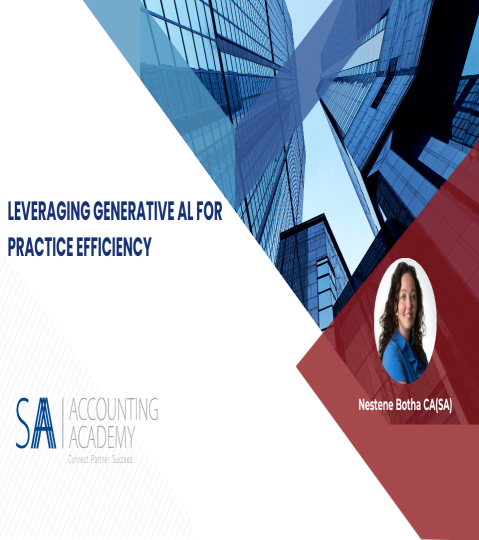
Watch the complete webinar: Leveraging Generative Al for Practice Efficiency.
For detailed insights and practical implementation strategies, register for the: AI for Accountants online course.
This article is based on insights from Nestene Botha CA(SA), she is a Course Builder, MBA Lecturer. Chartered Accountant, Fempreneur Coach and Masters in Auditing Education.